About Brass Cannon Studio…
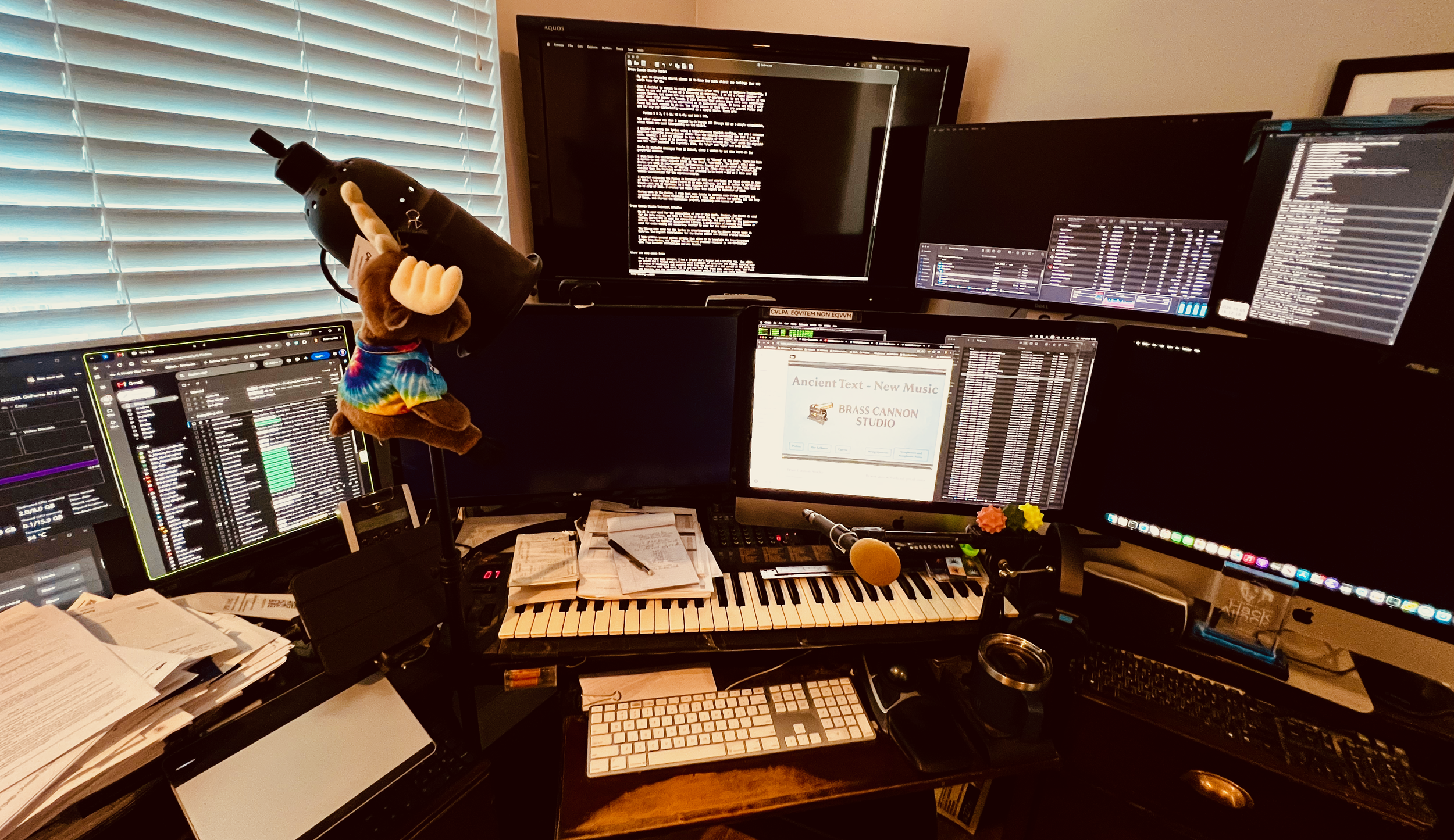
Technical Details
No AI is ever used for the composition of any of this music. However, Ace Studio is used for the Solo voices, and this is locally AI based for the production of those voices. Dorico Pro is used for composition and scoring. The VSTs used for the instruments are all from the EastWest SoundsOnLine Library. A combination of Audacity and Reason is used for audio mixing and rendering. Blender is used for the video production.
The Hebrew text used for the lyrics is transliterated from the Hebrew source texts in Sefaria. The English translations for the Psalms videos are JPS1917 (Public Domain).
I have written several python scripts that allow me to translate the transliterated lyrics from Dorico, and produce the different phonemes required by the WordBuilder VSTs from EastWest SoundsOnLine and Ace Studio.
Where the name comes from…
When I was very much younger, I had a friend who's father had a welding rig. One night, my friend and I filled many balloons with a mixture of acetyline and oxygen, covered them in sheets of newspapers and inserted them into the barrel of a WWI cannon in the park. We then attached some fuse cord, lit it and ran into the trees some distance away. The flash was amazing, and the reververations of the sound around the park was truly awesome!
Around that same time, I was reading a lot of Science Fiction. In one of Robert Heinlein's books, his character relates a story about a gentleman whose job was polishing the brass cannon outside the county courthouse. After a while, the man became rather ambitious, so he saved his money, bought his own brass cannon and went into business for himself.
My Music
My goal in composing choral pieces is to have the music elicit the feelings that the words have for me. My goal in composing non-choral pieces is to have the feelings that I have come through the music.
When I decided to return to music composition after many years of Software Engineering, I chose to set all 150 Psalms as a limbering up exercise. I am not a fluent speaker of modern Hebrew, but these are not modern lyrics. My approach was to set the Psalms in the order that they appear in Tanach. I also decided that unless there were some compelling reason, each Psalm would be approached as an individual piece. It turns out that I only found two such reasons to do so.
The first reason is that there are several Psalms that are (or may be) historically considered as a single Psalm. These are:
Psalms 1 & 2, 9 & 10, 42 & 43, and 144 & 145.
The other reason was that I decided to do Psalms 113 through 118 as a single composition, since these are used liturgically as the Hallel.
I decided to score the lyrics using a transliterated English spelling, but use a somewhat modified Sephardic pronunciation rather than the heavily Ashkenazic one that I grew up with. However, I did not attempt to have the soloists or the choirs use modern Israeli accents. Thus, there is no phonemic distinction used between the "tav" (with the dageish) and the "sav" (without the dageish). Also, the "alef" and "ayin" are both silent.
Psalm 51 includes passages from II Samuel, since I wanted to set this Psalm in its purported context.
I also have the tetragrammaton always pronounced as "Adonai" by the choir. There has been a custom to use other methods (such as "ha Shem", "ado-shem", "ha Makom", etc.) when Psalms are sung in non-liturgical performances. Anyone who would rather do that when they are performing these are, of course, free to do so. (This also applies to “Elohim”.) I decided that the Psalmist wrote what was intended to be heard - and so I have used the common vocalization for the unpronounceable.
I started composing the Psalms in November of 2021 and concluded the first drafts in June of 2024. I had started using Finale as my main software, but had to switch to Dorico when Finale went out of business. So I then reworked all 141 pieces using Dorico. This took me up to July of 2025. I created the video files from August to September of 2026.
During work on the Psalms, I also took some breaks to compose some string quartets and symphonic suites. Since composing the Psalms I have also written two operas, set the Song of Songs, and started the Resonances Project, beginning with Leaves of Grass.